This blog has moved
Please visit us at the new and improved site:
http://www.barefoothoofcare.net
Thanks!
October 29, 2013
This blog has moved
Please visit us at the new and improved site:
http://www.barefoothoofcare.net
Thanks!
August 4, 2013
I came across this post on my new favorite blog, Good Horsekeeping and thought I would share it. The focus is on the two extremes – from very unheatlhy to very healthy, but there is a lot of room in between the two. It is important to learn to recognize what hoof rings are telling you. It usually means there is some form of inflammation going on inside the hoof.
An upset in the horse’s metabolic system eventually shows itself in the hoof wall texture and horizontal rings. The hoof becomes a mirror of the internal imbalances.
MMP enzyme, (matrix metalloproteinase) controls the growth and direction of the laminae in the hooves. This enzyme is well regulated in a healthy system providing flexibility in the connective tissues of the hoof wall.The cecum, in the hind gut is part of the digestive process. It is a fermentation sac containing microbials that assist in breaking down the forage.When the diet is high in grains and sugars this causes the bacterial population of the hind gut to rapidly increase damaging the lining of the colon and releasing toxins into the bloodstream.
Eventually the toxins reach the hoof causing MMP’s to be released. In efforts to process the excess toxins MMP which is normally well regulated is released in abundance. The result is a separation of laminae. This is a painful and serious condition. The results are seen as horizontal warped rings on the hoof wall. See photo below.
The next photo is of a healthy hoof. You will notice no rings, a smooth surface with the coronary band even and smooth. There is about a half inch of new growth below the coronary band. This too is healthy and smooth.
There can be other causes for horizontal hoof rings; improper trimming, shoeing, concussion, abscesses, circulation issues and other metabolic syndromes.
A diet high in sugars, grains, and starches is one of the main contributing factor to hoof growth deformities and other health issues in the horse. The horse needs a diet high in fiber. They are grass eaters, not grain eaters.
February 8, 2013
This is an image of a cross section through a hoof with the shoe still attached and showing how the nail goes through the foot into the white line. It appeared originally The Hoof Blog, in a post discussing the use of MRI’s for diagnostic purposes and the proper removal of shoes
http://hoofcare.blogspot.com/2011/02/no-farrier-no-mri-diagnostic-imaging.html
This is a fascinating, rarely seen view of the shoe and nails penetrating the hoof. It is remarkable how close the nail is to the edge of the coffin bone. Click on the image for a larger view.

Hoof Cross Section With Shoe and Nails Attached
January 21, 2013
The transition from shod to barefoot almost always results in the white line growing in more tightly as a result of the absence of leverage of the wall away from the coffin bone due to the presence of the shoe. While the shod part of the wall is growing down, there is a ‘ridge’ visible where the white line has started to grow in more tightly.
The hoof is shod.

The hoof has been barefoot for the duration of approximately four weeks.

The hoof has been bare for about 4 months. The ridge that demarcates the place where the shoe was removed is approximately 2/3 down the wall. The growth above this line appears ‘closer’ to the bone because of the ‘tightening up’ of the white line. Notice also the improvement in the underrun heel which is now taller with a straighter angle.

June 11, 2012
For many inexperienced horse riders or owners, the prospect of having a horse without shoes might seem like a very unusual prospect but once it is considered that wild horses are extremely unlikely to be shoed then the prospect of barefoot care suddenly doesn’t seem so unusual.

Step One to the Barefoot Transition
Barefoot is an extremely popular aspect of holistic animal care where the hoof itself is trimmed. The practice came about as a result of the perceived harm which can be caused to the horse and its legs as a result of shoeing and it is for this reason that it has remained popular.
The Effects
Studies have shown that the wearing of shoes can prevent the hooves from expanding properly as the horse presses down. This can, in turn prevent the feet from absorbing the shock of the movement and could injure the horse during running.
There is further consideration that further health complications can arise from the hoof forming around the shoe, rather than in its natural form. (more…)
April 26, 2012
This is a moderately severe case of founder, with coffin bone visible. The horse had been shod as a two-year old show horse for years, but barefoot trimmed for several years prior to the founder. He had undiagnosed metabolic issues that became apparent when he foundered.


Left Right
February 19, 2012
There are approximately 300 different horse breeds and an estimated 6.9 million horses in the United States alone. Horses are used for everything from racing to simple trail rides. Their environments range from the black asphalt and concrete of large cities to the rugged mountain trails of Montana. My point is that there are thousands upon thousands of different uses and environments for horses, but some people advocate that there is only one approach to hoof care. On one side, natural hoof care advocates state that there is absolutely no use for shoeing a horse.  A select few might go as far as saying that shoeing a horse is abuse. On the other side, others zealously argue that natural hoof care is nothing more than a scam. The passionate debate between natural hoof care advocates and traditional farriers often drives a wedge between the two sides and makes it difficult to accept the merits on both sides.
Traditionally, the majority of farriers have been opposed to natural hoof care. There are several reasons for the opposition that can range from a simple resistance to change all the way to the misconception that natural hoof care takes money out of the farrier’s wallet. The opposition is often further ingrained when the very skills of a farrier are attacked. For example, Jaime Jackson, a noted expert on natural hoof care states, “The equine species is genuinely adapted to go barefoot. It is only through human ignorance of the horse’s natural state that led us to the incorrect, and harmful, conclusion that shoes are necessary — or useful. They aren’t, and, moreover, contribute significantly to the lameness we see everywhere around the world.” For the farrier’s point of view, this can be a harsh statement. It directly attacks the years of training, experience, and hard work required to become a professional farrier.
(more…)
October 21, 2011
My barefoot horse Webster and I participated in the Ride for The Cure on October 16, 2011. We were on the Bow Brickhill Stables Team. Bow Brickhill is located in Milford, NJ, and we trailered the one mile over to the Alexandria Equestrian Association Park where the ride began.
Here are some views from the Ride, they will be up until November 11, 2011.
https://vando.imagequix.com/proof.html?id=49WEF9G&eventid=1071%2D2680%2D0011#preview
https://vando.imagequix.com/proof.html?id=49WEF9G&eventid=1071%2D2680%2D0011#preview
https://vando.imagequix.com/proof.html?id=49WEF9G&eventid=1071%2D2680%2D0011#preview
https://vando.imagequix.com/proof.html?id=49WEF9G&eventid=1071%2D2680%2D0011#preview
And here we are cantering in the ring at home:
October 21, 2011
I ran across this old article recently in the May 1999 issue of Anvil Magazine. It is a writeup from the Bluegrass Laminitis Symposium from the same year. It summarizes the talks that were presented, one of which was by Dr. Christopher Johnston, DVM, PhD, on the study of the effect of shoes on hoof expansion:
Christopher Johnston, DVM, PhD, spoke about Impact in the Athletic Horse; about Heel Expansion; and also about Objective Biomechanical Testing of Horseshoes. Dr. Johnston finds that a softer surface may absorb as much as 90% of the impact forces. In his laboratory studies, as much as 80% of the impact force on the limb is absorbed in the hoof, before it reaches P2.
Dr. Johnston outlined three possible explanations for heel expansion of the hoof under load: the frog pressure theory, the depression theory, and the hemodynamic theory. Every one of these may play a part. Using a thin wire attached to the heels and a potentiometer, Dr. Johnston found about 1 mm (1/24 of an inch) expansion at the heels under load, followed by contraction of the heels as the hoof approached breakover during motion. Shoes decreased the amount of expansion and contraction.
I found this short blurb interesting in that it states matter of factly that shoes prevented expansion of the hoof. There’s no way to tell what if any discussion was generated at the symposium, but this study is over ten years old and it appears to have died a quiet death. I think this is a far more significant finding than there is credit being given, as most farriers and authors will dispute that shoes prevent hoof expansion.
I have not been able to find anything on the original study by Dr. Johnston. If anyone is familiar with where to locate it, please post.
Link to article:
http://www.anvilmag.com/farrier/bls.htm
June 18, 2009
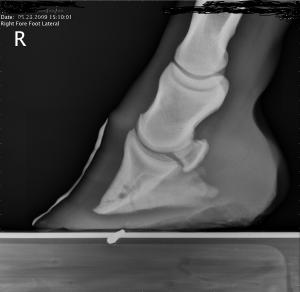
Club Foot
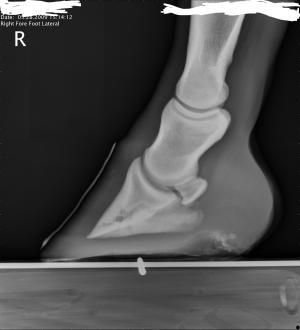
Not Club Foot
 | Christina on Sidebone Xrays |
| Jane 'stompin' Timpa… on Sidebone Xrays | |
 | Julia King on No More Ringbone |
| Christina on No More Ringbone |
| Julia King on No More Ringbone |


 Barefoot Hoofcare